
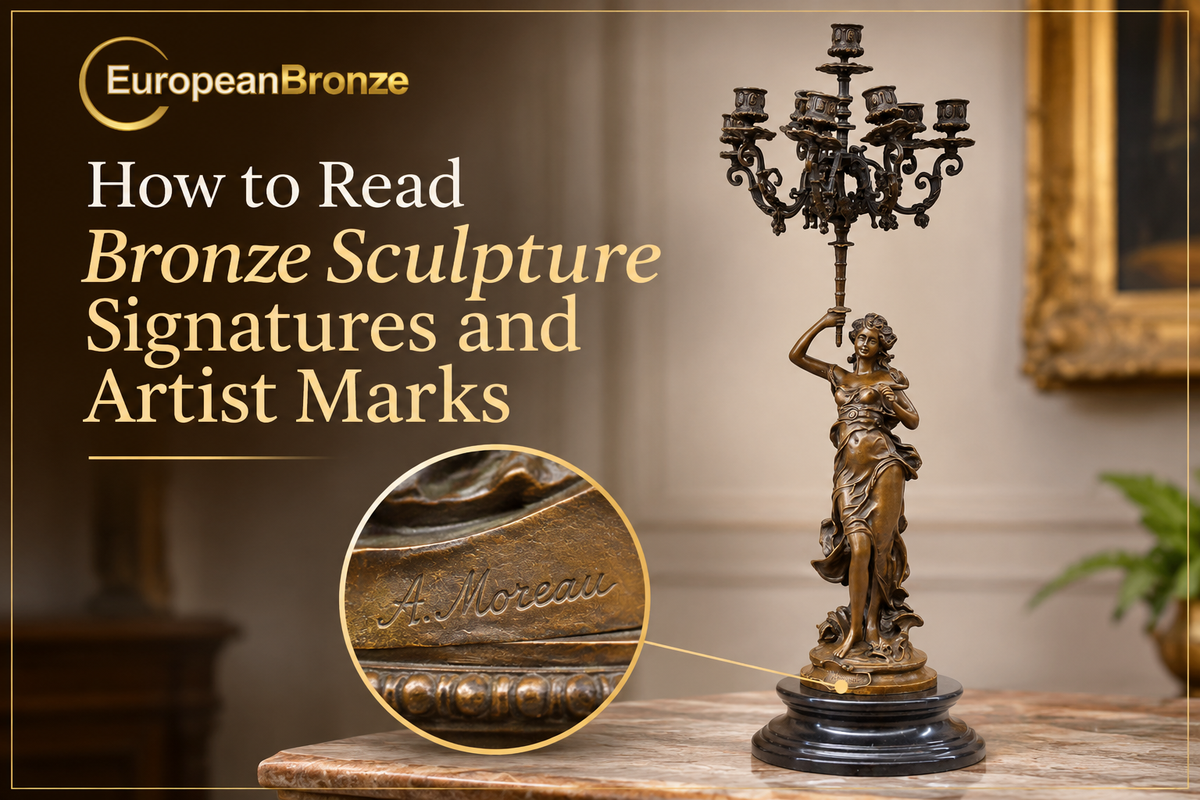
A small signature on the base of a bronze sculpture can tell you much more than the name of the artist. It may point to the sculptor, foundry, edition, casting date, or even the history of a particular cast.
But there is a catch: not every mark on a bronze belongs to the artist.
A foundry may have added its own stamp. A collector may have written an inventory number. A later reproduction may carry a copied signature. In some cases, even a genuine artist's signature can appear on several casts of the same work.
The Getty Museum's 2025 Guidelines for the Technical Examination of Bronze Sculpture note that marks can identify the artist, founder or foundry, edition, date, owner, model, title, or production process.
So, if you are trying to understand bronze sculpture signatures, the first rule is simple:
Don't read the signature alone. Read the entire group of marks.
What Can You Find on a Bronze Sculpture?
Before trying to identify a signature, it helps to understand what you are actually looking at.
Artist Signature
This is the mark most people look for first. It may be the artist's full name, initials, monogram, or a stamped version of their signature.
Its location can vary. It may appear on the base, near the feet of a figure, along the edge of the sculpture, or in another discreet area.
Foundry Mark
A foundry produced the bronze from the sculptor's model. Its name or symbol may appear beside or away from the artist's signature.
The Smithsonian American Art Museum specifically warns that names found on sculptures do not always belong to the artist. Foundry or fabricator names often appear on the base or another less visible area.
Edition Number
You may see a marking such as: 5/12
This generally identifies the fifth cast in an edition of twelve.
Getty defines an edition as a group of substantially similar casts made from the same original model or mold system.
Date or Other Numbers
Numbers can represent dates, inventory numbers, project numbers, cast numbers, or other production information.
This is why simply seeing a number beside a signature is not enough to determine what it means.
How to Read Bronze Sculpture Signatures Step by Step
1. Photograph Every Mark Before Trying to Interpret It
This is one of the most useful steps for a buyer or collector.
Take clear photographs of:
-
The signature
-
The underside of the base
-
Numbers and letters
-
Plaques
-
Labels
-
Any unusual symbols
Use both a straight-on photograph and a close-up from an angle.
Getty's technical guidance notes that detailed visual examination can reveal tool marks, inscriptions, casting details, repairs, and other evidence that may not be obvious during a casual inspection.
Why does this matter?
A mark that looks like "A. B." from a distance may turn out to be a longer name or a foundry abbreviation when photographed properly.
2. Identify the Location of the Mark
The location itself can provide useful information.
An artist's signature may be placed prominently on the sculpture, while a foundry mark may be positioned on the base or another less noticeable area.
For example, a Smithsonian record for Theodore Parker documents the artist's signature on one side of the bronze base and the foundry mark on the opposite side.
3. Separate the Artist's Name From the Foundry Name
This is where many first-time buyers make mistakes.
Imagine a bronze has these markings:
PAUL MANSHIP
ROMAN BRONZE WORKS, N.Y.
The first identifies the artist, while the second identifies the foundry.
The National Gallery of Art records both marks on Paul Manship's Indian Running with Dog: the artist's name and the Roman Bronze Works foundry mark.
So when researching bronze sculpture makers marks, search the names separately rather than assuming every inscription refers to the sculptor.
4. Look at How the Signature Was Made
The physical appearance of the mark matters.
Was it:
-
Stamped into the metal?
-
Incised by hand?
-
Raised from the casting?
-
Added to the wax before casting?
-
Engraved after casting?
Getty explains that signatures and edition marks can be added to the wax model before the bronze is cast. Foundry marks can also be stamped during production.
This makes the mark part of the sculpture's manufacturing history rather than simply a label added afterward.
But don't assume one technique automatically proves authenticity. Different artists, foundries, and periods used different methods.
Bronze Sculpture Signatures Can Be More Complicated Than They Look
A Signature Does Not Automatically Mean “Original”
This is perhaps the most important point in the entire guide.
Bronze is different from a painting because the same sculptural model can be used to produce multiple casts.
The Met explains this particularly well through Rodin's work: multiple foundries produced casts during his lifetime, creating numerous versions and confusion about authenticity. Some casts lacked foundry marks, while others lacked the artist's signature.
So finding an artist's name does not answer every question.
You still need to determine:
Which work is it?
Which cast is it?
When was it cast?
Who cast it?
Does the mark match known examples?
A Fascinating Example: Edgar Degas
Edgar Degas provides a useful real-world example of why bronze marks need careful reading.
After Degas died in 1917, more than 150 sculptures were found in his studio, most made from wax, clay, or plastiline. His heirs later authorized bronze casts from 72 figures. The contract called for editions of 20 casts, plus one for the foundry head and one for Degas' heirs.
But the actual marking system became more complicated.
The Met records examples carrying:
Degas
A.A. Hébrard
40/A
Here, these marks work together to identify the artist, foundry, and cast.
The National Gallery of Art likewise documents Degas bronzes carrying his stamped signature, the A.A. Hébrard foundry mark, and cast identifiers such as 50/M and 21/B.
This is a good lesson for anyone researching sculpture signatures: a group of marks can be far more informative than one signature.


Common Bronze Sculpture Marks and What They May Mean
|
Mark |
What It May Indicate |
What to Check |
|
Artist's name |
Sculptor or reproduced artist signature |
Compare with authenticated examples |
|
Initials/monogram |
Artist, foundry, or workshop |
Research the exact symbol |
|
Foundry name |
Where the bronze was cast |
Check whether the foundry worked with the artist |
|
5/12 |
Cast number and edition size |
Verify the documented edition |
|
Date |
Production or casting date |
Check whether it fits the artist's history |
|
Inventory number |
Collection, museum, or dealer reference |
Research provenance |
|
Copyright mark |
Artist or rights holder |
Check period and context |
|
Workshop mark |
Studio or production workshop |
Compare with known examples |
Getty also notes that founder's marks can change over time, vary in style, and sometimes contain numbers.
How to Research Antique Bronze Foundry Marks
If you find an unfamiliar mark, don't immediately search the entire inscription as though it were an artist's name.
Start With the Exact Letters
Write down every visible letter and number.
For example: A.A. HEBRARD is much easier to research than a vague search for “old French bronze mark.”
Compare Known Museum Examples
Museum collection records can be particularly useful because they often separate the artist, founder, date, medium, and inscriptions.
The Met, National Gallery of Art, and Smithsonian all provide examples where artist and foundry marks are documented separately.
Check Whether the Foundry Fits the Artist
A convincing-looking foundry mark becomes much more meaningful when historical records show that the foundry actually produced work for that artist.
If the dates do not overlap, however, the mark deserves closer scrutiny.
When Should You Get Professional Help?
For an inexpensive decorative piece, reading the marks can be an interesting research exercise.
For an expensive or supposedly rare bronze, the stakes are different.
A specialist may examine the sculpture under magnification, compare inscriptions with known examples, study casting and chasing marks, inspect the internal structure, and use techniques such as X-radiography or XRF when appropriate. Getty lists visual examination, microscopy, radiography, elemental analysis, and other methods as part of technical bronze examination.
The goal is not simply to answer “Is this signature real?”
It is to understand whether the signature, foundry, casting method, edition, date, and sculpture itself tell the same story.
Final Thoughts
Reading bronze sculpture signatures is a little like reading a sculpture's production history. The artist's name may tell you who created the design, while the foundry mark can reveal who turned that design into metal. Numbers may identify a particular cast, and dates or inventory marks can add another layer to the object's history.
The most reliable approach is to treat every mark as a clue rather than a final answer. When several clues agree, and museum records, provenance, and physical evidence support them, you have a much stronger basis for understanding the bronze in front of you.
FAQs
Where are bronze sculpture signatures usually found?
They can appear on the base, plinth, near the feet of a figure, or another discreet area. Foundry marks are also commonly found on the base or less visible sections.
Does a foundry mark prove a bronze is authentic?
No. A foundry mark identifies a possible casting source, but it should be checked against the artist, date, edition, and known examples.
What does 3/12 mean on a bronze sculpture?
It generally means the third cast in an edition of twelve. The documented edition should be checked before drawing conclusions.
Can a bronze have an artist's signature but still be a later cast?
Yes. Multiple casts can be made from the same model, and later casts may still carry the artist's name or a stamped version of the signature. Rodin's bronzes are a well-known example of this complexity.
How can I identify an unknown antique bronze foundry mark?
Photograph the mark clearly, transcribe every letter and number, then compare it with museum records, foundry references, and documented works by the suspected artist.