
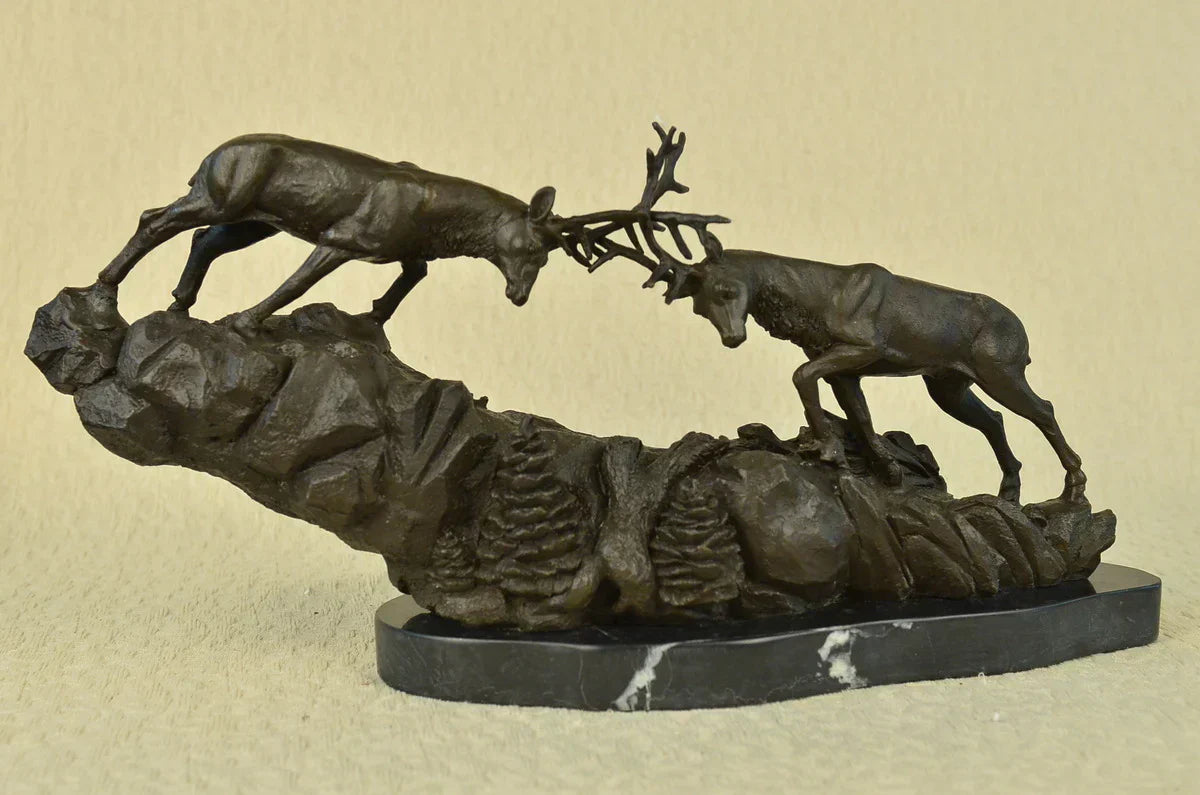
Why do humans always get attracted to animals? Especially the wild ones? Since the prehistoric era, animals have been the favorite subject of early man's carvings, paintings, and sculptures.
They signify more than just beauty. The qualities like strength, survival instinct, and freedom are a few attributes of wildlife that human beings desire to emulate in their everyday life. This connection, however, remains till today, though it is becoming even stronger.
With natural habitats disappearing, almost 70% of the global wildlife has gone down in the last 50 years, and the gap between humans and wildlife is getting wider. And it is exactly this gap that art tries to fill.
Wild animal statues are not only ornamental pieces, but they also serve as symbols of nature that we are gradually losing. They help to bring us closer to the outdoors, show raw power and motion, and provide a vibe of life within very ordered settings.
Therefore, bronze wildlife statues are the ones that depict the most. They not only portray animals; they depict the precise moment of life's highest intensity. A jump, a run, a flight. And somehow, they make it seem as if the movement is still happening... even when it's not.
Why Bronze Makes Motion Possible (When Other Materials Fail)
The ability to capture motion begins with the material itself, and bronze plays a major role here.
Bronze behaves in a way that most materials don’t. When molten, it expands slightly before settling into the mold, allowing it to capture extremely fine details. As it cools, it contracts just enough to release cleanly from the mold without losing definition.
This is critical when sculpting animals in motion.
Think about what needs to be preserved:
-
Tension in muscles
-
Subtle shifts in posture
-
Flow of fur, feathers, or skin
-
Extended limbs that appear unsupported
Bronze allows all of this.
Even structurally, it holds strength where other materials might fail. A rearing horse or a lunging predator can be cast in bronze without collapsing or losing balance.
That’s why artists consistently choose bronze for dynamic forms, it gives them freedom to push movement further without compromising stability.
The Real Work Happens Before the Sculpture Begins
Before any clay is shaped or metal is cast, sculptors spend time understanding the subject.
Wildlife sculptors don’t rely on imagination alone; they rely on observation.
Many travel to natural habitats, studying how animals move, rest, react, and interact. Artists like renowned wildlife sculptor Hamish Mackie have built entire careers around observing animals in real environments before translating them into sculpture.
This phase involves:
-
Watching movement patterns repeatedly
-
Studying muscle structure and skeletal alignment
-
Capturing motion through sketches and photography
-
Building small study models to test posture
This is what separates a static figure from a lifelike one.
Because a lion standing still and a lion about to pounce are two completely different forms, even if the anatomy is the same.
The Core Artistic Challenge
Capturing motion in sculpture is essentially solving a contradiction:
How do you show movement… in something that cannot move?
Sculptors approach this challenge using a combination of visual strategies.
First, they focus on moment selection. Instead of choosing a neutral pose, they capture the peak of action, the exact instant where energy is highest. A fraction too early or too late, and the sculpture loses its intensity.
Second, they use directional flow. Every line in the sculpture, whether it’s the curve of a spine, the angle of a leg, or the spread of wings, is designed to guide the viewer’s eye. Your gaze follows these lines, and in doing so, you perceive motion.
Third, there’s controlled exaggeration. Artists subtly extend limbs, arch backs, or stretch posture beyond natural limits, not enough to distort reality, but enough to amplify movement.
Finally, there’s balance and tension. A sculpture might physically rest on a small base yet visually appear as if it’s about to leap forward. This is achieved by carefully distributing weight and creating opposing forces within the form.
This is why high-quality wild animal statues feel alive, they don’t just represent animals, they recreate energy.
From Clay Model to Bronze Form
Once the motion is defined, the sculpture moves into the casting phase, most commonly using the lost-wax method.
This process is as much about precision as it is about artistry.
It typically involves:
-
Creating a detailed clay or wax model
-
Building a mold around the model
-
Melting the wax out to create a cavity
-
Pouring molten bronze into the mold
-
Refining, polishing, and finishing the final piece
This technique has been used for thousands of years because it preserves even the smallest details, down to surface textures and tool marks.
In complex animal sculptures, different parts may be cast separately and assembled later to maintain accuracy and structural integrity.
The end result is a piece that carries both the artist’s intention and the raw physical detail of the original model.
Scale Doesn’t Change the Story: From Monumental to Miniature
One of the most interesting aspects of bronze animal sculptures is how they function across different sizes.
Large wild animal statues are often designed for public spaces, luxury homes, or outdoor installations. These pieces command attention. They are meant to dominate space and act as focal points.
But smaller pieces, especially miniature bronze animal figurines, serve a different purpose.
They are:
-
More intimate
-
Easier to collect
-
Suitable for indoor display
-
Often more detailed relative to size
Despite their scale, they carry the same artistic complexity. In fact, working at a smaller scale often requires even greater precision, as every detail becomes more visible.
Historically, small bronze figurines have been widely produced and preserved across cultures due to their portability and durability.

Why Demand for Wildlife Sculptures Is Growing
The appeal of bronze animal sculptures isn’t just artistic, it’s also cultural and emotional.
People are increasingly drawn to objects that represent the following:
-
Nature
-
Strength
-
Freedom
-
Raw, untamed energy
In modern environments dominated by technology and structured design, these sculptures bring something organic and unpredictable into the space.
And the demand is rising.
The global art and sculpture market is projected to grow significantly, with strong interest from collectors and interior designers driving expansion.
At the same time, auction data shows a 20–30% increase in sculpture offerings since 2017, along with a 30–40% rise in average selling prices, clear signs of growing demand.
This growth is also linked to:
-
Rising interest in physical, tangible assets
-
Increased participation from high-net-worth collectors
-
Greater integration of sculptures into interior design
In short, sculptures are no longer niche, they are becoming central to both design and collecting.
Conclusion
Bronze animal sculptures are not merely visual representations of animals. They embody the artist's observation of life, knowledge of anatomy and movement, and transparency of the performers' gestures after being translated physically through sculpture.
The interpretation and realization of a brief moment in the life of an animal can be captured in a perpetual form by way of the sculpture that is energized and realistic. Moreover, from a market perspective, their presence in the art world is justified.
By 2025, the worldwide art and sculpture industry is forecasted to almost double in size, from approximately $43 billion to $88.7 billion, fueled mainly by collector demands and the interest of acquiring culturally significant tangible assets.
Concurrently, bronze as a medium keeps its merchandising power since, apart from being highly resistant and possessing an extraordinarily long base, it is constantly sought after in different industries.
If you want to get hold of genuine artisanal works, European Bronze is an example where one can find various bronze sculptures reflecting both technical skill and artistic details.