
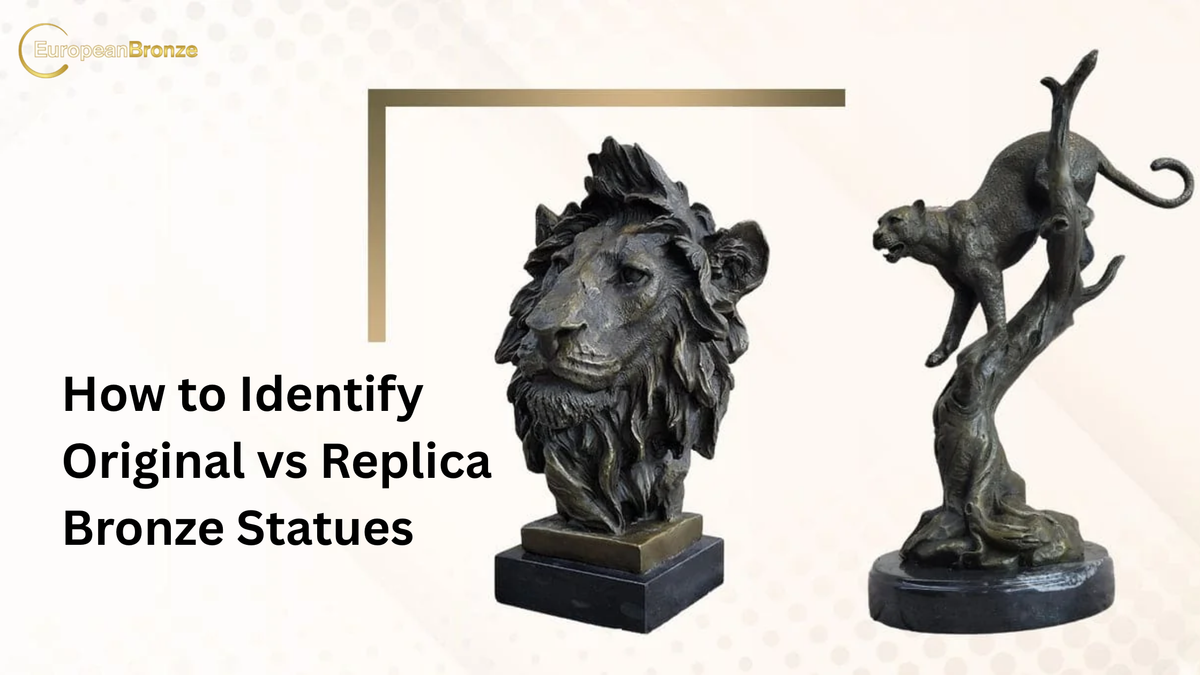
A bronze statue may appear to be a convincing reproduction, but the material, casting, finish, markings, and the circumstances surrounding its creation can tell a different story.
It is crucial to know how to identify authentic bronze statues for collectors and buyers before spending a lot of money on something that is described as an original.
The problem is, not all reproductions are bad. Everything can be convincingly detailed, with a faux patina, artist-signed, and even reproduced with a foundry mark.
So how do you know if it's a genuine bronze sculpture or a replica?
There is no one magical test. Rather, you must analyze a number of clues collectively, ranging from the metal itself to the sculpture's origin.

What Makes a Bronze Sculpture “Real”?
Bronze is a copper-based alloy, typically with the addition of tin, zinc, lead, or other elements. It may consist of various ingredients depending on the time, artist, foundry, and casting process.
A real bronze sculpture is more than just a physical sculpture crafted out of the metal. However, if an artist states that it is an original, collectors should ask who the artist is, where it was cast, when it was cast, if the artist has made any other casts of the piece and if the physical characteristics of the artwork justify the artist's claim.
This is important because the same sculpture design can be used to create a bronze cast that is the same design but not the historically important cast that the seller states it is.
How to Identify a Bronze Sculpture: 7 Things to Check
1. Start With the Sculpture's Weight and Feel
A resin or plaster cast is normally much lighter than a real bronze statue of a comparable size, because bronze is a dense metal.
But don't use weight as proof.
Bronze sculptures are often hollow castings, especially those of larger size. The hollow bronze can thus be quite light. It is also possible to use metal or other materials that will affect the weight of a resin sculpture.
Better approach: compare the weight and size of the object with its construction. When a seemingly solid bronze statue is quite light, inquire about its contents.
2. Look for the Artist's Signature
The signature is one of the first places buyers look, but it is also one of the easiest details for a replica maker to copy.
Look at:
-
The location of the signature
-
Letter shapes and spacing
-
Depth and character of the mark
-
Whether the mark appears to belong to the casting
-
Whether authenticated examples use the same signature style
Getty's technical guidance notes that signatures and edition marks can be incorporated into the wax model before casting.
That means the signature should not look like an unrelated engraving added years later without explanation.
3. Check the Foundry Mark
A foundry mark can provide one of the most useful clues when you bronze sculpture identify.
Foundries produced the metal casting from an artist's model, and their names, symbols, or marks may appear on the base or another less visible area.
But here is an important point:
A foundry mark does not automatically prove that a sculpture is an original.
A reproduction can copy a legitimate foundry mark from an earlier cast. The mark needs to match the sculpture's documented history, location, style, and period.
4. Study the Patina
Patina is often treated as the “age test” for bronze. That is misleading.
Bronze can develop different surface colors, including brown, black, green, and blue-green tones. More importantly, artists and foundries can deliberately create patinas using chemicals. Historic England notes that artificial patination has long been part of bronze production.
So a dark or green surface does not automatically mean an old sculpture.
Instead, examine whether the surface treatment makes sense across the sculpture. Look at recesses, raised areas, corners, seams, and areas that would naturally receive handling or wear.
A uniformly colored surface may deserve more investigation than one with varied finishing and documented treatment.
5. Examine Casting and Tool Marks
This is where looking closely can reveal much more than looking at the overall appearance.
Bronze casting can leave traces of the production process. Getty's technical research notes that as-cast surfaces may contain porosity, bumps, flashes, and other small imperfections, while areas that were later chased or worked can show different tool marks.
Look around:
-
Seams
-
Fingers and facial details
-
Hair
-
Fabric folds
-
Undersides
-
Areas where separate components meet
A good bronze does not have to be perfectly imperfect, and a replica does not have to be rough. The important question is whether the marks make sense for the claimed casting process.
6. Look for Edition Numbers
Many modern bronze sculptures are produced as limited editions. You may find markings such as 3/12, indicating a particular cast within an edition.
But edition numbers need context.
Check whether:
-
The artist actually produced the work as an edition
-
The stated edition size matches documented records
-
The numbering style matches known examples
-
The location of the number is consistent
-
The seller can provide supporting documentation
The Metropolitan Museum of Art notes that documented foundries and cast numbers can be important when studying multiple casts of the same sculpture.
7. Investigate Provenance Before You Buy
This is arguably the most overlooked part of Bronze Sculpture Authentication.
Physical inspection tells you what the object looks like. Provenance helps explain where it came from.
Useful documents can include:
-
Previous invoices
-
Gallery records
-
Exhibition labels
-
Auction records
-
Certificates of authenticity
-
Estate documentation
-
Previous appraisal reports
-
Published catalogue references
Even a convincing sculpture becomes difficult to authenticate if its claimed history cannot be supported.
Real Bronze Statues vs Replica: Quick Comparison
|
Feature |
Likely Real/Authentic Bronze |
Potential Replica or Questionable Piece |
|
Material |
Copper-based bronze alloy |
Resin, cold-cast material, spelter, brass, or another substitute |
|
Weight |
Substantial for its construction |
Often unusually light for its size |
|
Patina |
Can show varied surface treatment and age-related changes |
May appear overly uniform or artificially aged |
|
Signature |
Matches documented examples |
Incorrect style, position, or execution |
|
Foundry mark |
Consistent with known casting history |
Copied, unusual, or unsupported mark |
|
Edition number |
Matches documented edition records |
Numbering cannot be verified |
|
Casting details |
Production and finishing marks make sense |
Inconsistent or crude details |
|
Provenance |
Supported by records or credible history |
Little or no verifiable history |
What About the Magnet Test?
Sometimes a magnet test is given as a quick method to identify bronze.
It may be helpful as a simple screening test but should not be used as an authentication test.
Generally, bronze does not have magnetic properties, but a sculpture may also have other materials or components of the structure that are magnetic. However, a non-magnetic result does not necessarily mean the object is bronze, it may just indicate a need for further investigation.
For a high-dollar sculpture, it's far better to use material analysis than household tests. The composition of bronze can be analyzed to gain insights into the history, origin, and authenticity of the casting.
When Should You Ask an Expert?
If the sculpture is inexpensive, and you just wish to see if it is decorative bronze, a simple inspection may be sufficient.
With a high-value piece, however, never rely on the patina, the weight, the signature, or the foundry marks.
A professional specialist can compare the sculpture with authenticated examples, examine the sculpture's casting and tools, study the alloy, consider the artwork's provenance, and determine if the sculpture is consistent with the artist's known work.
This is especially critical, as an authentic bronze design and an actual historical cast aren't necessarily the same. So, if you are looking to buy authentic and antique bronze sculptures, then it’s time to explore the European Bronze unique collection of bronze sculpture.

Final Thoughts
Learning how to bronze sculpture identify is less about finding a single “secret” test and more about putting several pieces of evidence together.
Start with the material and weight. Then inspect the signature, foundry mark, edition number, casting details, patina, and provenance. If those clues point in the same direction, your confidence becomes much stronger.
Most importantly, remember that a convincing replica can copy the appearance of a famous bronze. What it cannot easily copy is a well-documented chain of ownership, a matching casting history, consistent technical evidence, and a credible connection to the artist or foundry.
That is what separates simply owning a bronze statue from knowing that you have a real bronze sculpture with a defensible history.
FAQs
How can I tell if a bronze statue is real?
Start by checking its material, weight, casting details, surface finish, signature, foundry marks, and provenance. A genuine bronze statue is generally made from a copper-based alloy, but appearance alone cannot confirm authenticity. For valuable pieces, professional material testing and provenance research may be needed.
Are real bronze statues magnetic?
Most bronze alloys are not strongly magnetic. However, the magnet test is only a basic screening method and cannot confirm that a sculpture is genuine bronze. A sculpture may contain other metals or structural components, while some non-bronze materials may also produce misleading results.
How do I identify a bronze sculpture by its markings?
Look at the base, underside, plinth, and less visible areas for an artist's signature, foundry mark, edition number, date, or other inscription. Compare these details with documented examples of the same artist or foundry. A mark is useful evidence, but it should not be treated as proof by itself.
Does a foundry mark prove that a bronze sculpture is original?
No. A foundry mark can tell you where a sculpture may have been cast, but reproductions and later casts can sometimes carry copied or legitimate-looking marks. The mark should be checked against the artist, casting period, edition records, physical characteristics, and provenance.
Can a replica bronze sculpture have a real artist's signature?
Yes. A reproduction may copy an artist's signature or may have been produced from an existing mold that originated from an artist's work. This is why finding a familiar signature does not automatically mean you have an original or historically significant cast.